
I. Why Your Math Isn’t Adding Up
Have you ever felt like you’re doing everything “right,” but your body isn't getting the memo?
You’re hitting your miles, hitting your macros, and checking every box your coach gives you—yet the bones are still breaking. It’s frustrating, it’s exhausting, and it’s confusing. Most of the time, the world will tell you that you just aren't eating enough (the RED-S trap). But I want to offer you a different perspective.
I call it Under-Integration. It’s not that you aren’t doing enough; it’s that your internal “logistics” are jammed. Your body has the fuel, but it can’t get the supplies to the construction site. The good news? Bone remodeling is a good thing! Your body actually wants to upgrade your chassis to handle the miles. We just have to make sure the gates are open.
II. The "Normal" Trap: A 2018 Retrospective
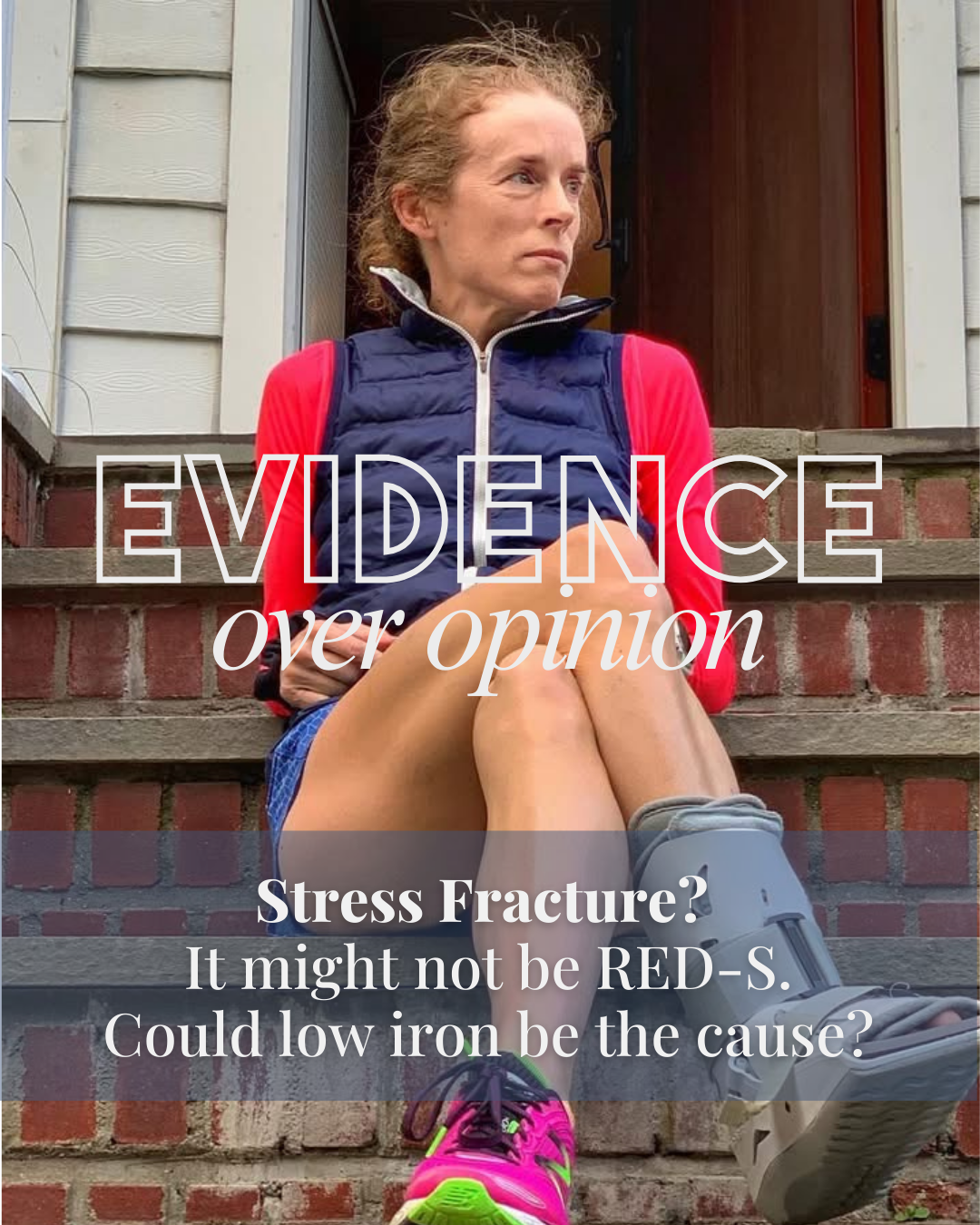
I’ve been where you are. In August 2018, I was sidelined with a stress fracture. Looking back at my labs from that year, the "Evidence" was hiding in plain sight, even though my doctors said I was "Normal."
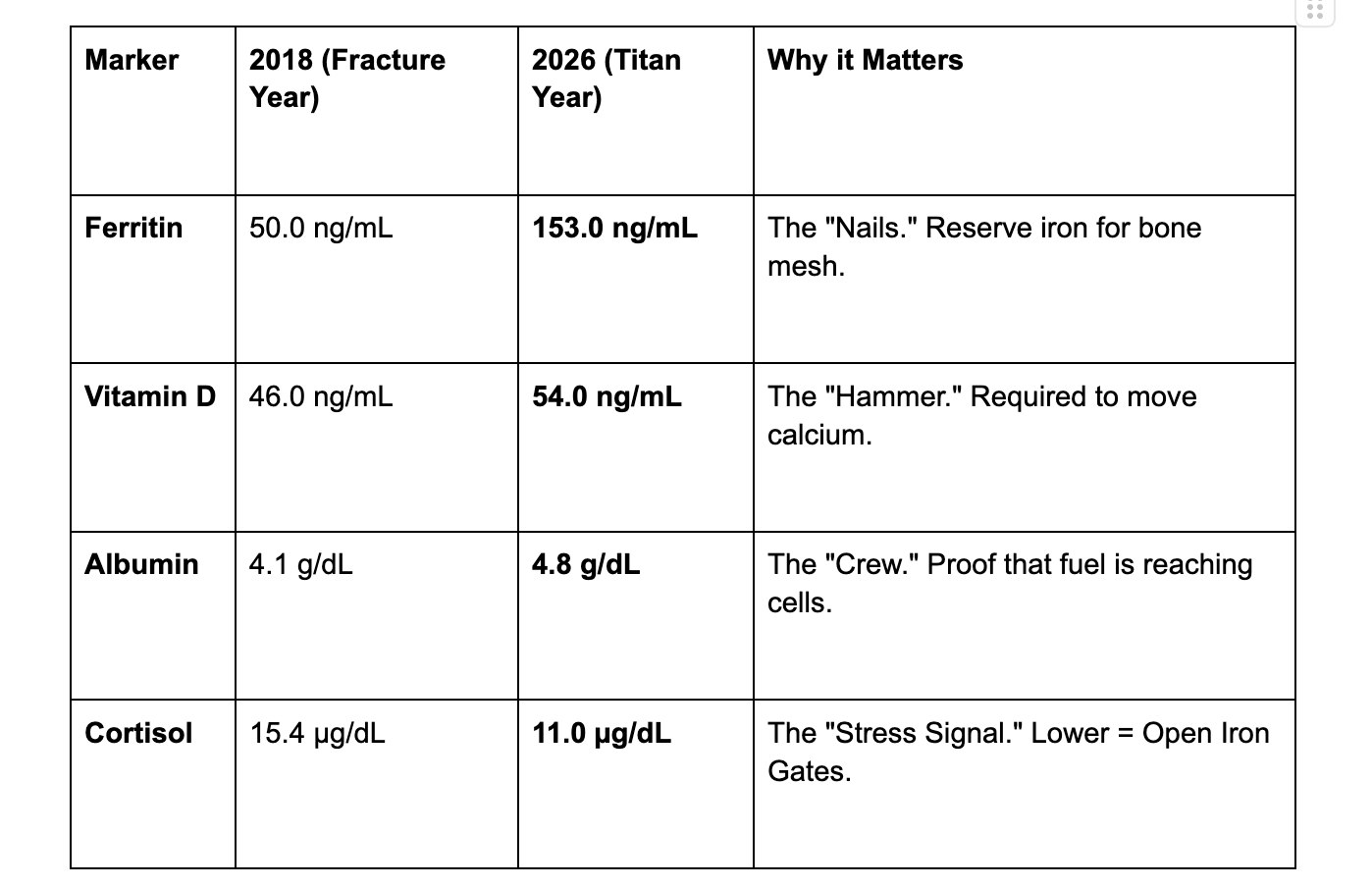
The Vitamin D Debt: I hit a 29.0 ng/mL. In the medical world, 30 is passing. In the athlete world, 29 is a structural hazard.
The Hormonal Shift: My Testosterone-to-Cortisol (T:C) ratio plummeted from a 70 down to a 43 in just a few months. My body had shifted from "Building Mode" to "Survival Mode."
I looked "fine" on paper, but I was structurally vulnerable. I was trying to build a high-performance engine with low-grade parts.
III. The Logistics of Bone (The Iron Link)
This is where we need to talk about Iron. Think of bone remodeling like a home renovation. Your training creates the "micro-stress" that tells your body it's time to upgrade. But you can't build a house without the nails. In your body, Iron is the nail. Iron is a critical co-factor for collagen synthesis—the flexible "mesh" that gives your bones their strength. Without enough iron, your "Bone Builders" (osteoblasts) are essentially standing around an empty construction site with no supplies. They want to work, but the gate is locked.
(For a deep dive into how the "Iron Gatekeeper" works and how to check your levels, see my post on The Silent Thief of Performance - Ferritin Deficiency.)
IV. Meet the Gatekeeper: The Science of Stress
High training stress and psychological pressure trigger a hormone called Hepcidin. Think of it as a gatekeeper in your gut. When Hepcidin is high, it locks the doors. The Iron you eat never makes it to your blood; it just stays in the driveway. When we fix the environment—lowering stress and opening that gate—the remodeling process finally succeeds. You aren't fragile; you're just waiting for a delivery.
V. The Lifestyle Pillars: Choosing Your Preference
I know the pressure you're under. Whether you're a high schooler chasing a D1 scholarship or a professional balancing a career with a 50-mile week, the "Total Load" is heavy.
The TikTok Trap & The Attention Economy: I'm not telling you to delete the app, but I want to talk about Preference. That 11:00 PM scroll feels like a reward, but it’s actually stealing your recovery. It spikes "Micro-Cortisol" and pushes your sleep into the danger zone. You get to choose: the 15-second dopamine hit, or being a Conference Champion?
The Alcohol Trap & The 2 AM Wake-Up: In my 40s, I fell into the trap of thinking I "deserved" a glass of wine at night. But I found that while I'd fall asleep fast, I'd wake up at 2:00 AM with a racing heart. My heart was running a race while I was trying to remodel my bones! I chose to stop. Your liver can either process your training or your happy hour—it’s much better at doing one at a time.
VI. The GI Gate: Celiac and Absorption
If you have Celiac disease or chronic gut inflammation, your "Construction Site" is already under siege. My GI system was off-track for years, which meant the gates weren't just locked—they were damaged. I had to spend significant time integrating my gut health before my bone health could follow. If you’re struggling with absorption, check the foundation of your GI tract first.
VII. My Supplement Architecture (The Timing Strategy)
People ask me what I take, but the real question is "When do you take it?"
Morning (The Build): I take Vitamin Code Grow Bone first thing to provide the calcium and raw materials my body needs. No iron here.
Bedtime (The Iron): I take my iron right before sleep. Why? Because after a 5:00 PM practice, your Hepcidin (Gatekeeper) is at its peak. If you take iron then, it's a waste of money. By bedtime, the gates have opened. For the high schooler who barely has time to brush their hair in the morning (I remember the days of the perfectly formed curling iron bangs!), bedtime is the easiest win.
VIII. The "Boring" Champion
My best year of running was my senior year of college. I made a choice that felt "boring": I stopped going out after races and embraced a non-negotiable 10:00 PM bedtime. I didn't miss the parties because I was busy standing on the podium as a Conference Champion. When you prioritize integration, the results speak louder than the social pressure.
IX. Your Actionable Roadmap: Normal vs. Optimal
Don't let a doctor tell you that you're "Normal" if you're chasing "Optimal."
X. The Advocacy Playbook: Talking to Your Doctor
Most doctors will refuse to check Ferritin. If they say it's "not necessary," tell them: “As a high-mileage runner, my iron turnover is significantly higher. I am monitoring my Ferritin to ensure my bone remodeling has the necessary co-factors to prevent structural failure.” If they still refuse, own your data and order a private test. You are the architect of your own integration.
Conclusion: You are the Architect
The "Boot" is just a temporary pause. By focusing on integration—the timing of your fuel, the quality of your sleep, and the management of your stress—you give your body permission to come back stronger. Let’s build something that never breaks again.
See our athletes & nutrition post for what you should be looking for.
Sonja and Jennifer are sharing their personal experiences. This is being provided for informational purposes only. We are not giving medical advice and you should always consult your own doctor for advice related to your own health.
The "How To Prevent Bone Stress Injuries" Bibliography
On Hepcidin and Iron Absorption:
Sim, M., et al. (2019). "Iron considerations for the athlete: a narrative review." European Journal of Applied Physiology. (This explains the "Gatekeeper" effect and why training spikes Hepcidin).
On Collagen and Iron as a Co-factor:
Shoulders, M. D., & Raines, R. T. (2009). "Collagen Structure and Stability." Annual Review of Biochemistry. (Validates "Iron is the nail" analogy—specifically the role of prolyl hydroxylase).
On Ferritin and Athletic Performance:
Burdick, N., et al. (2020). "Iron Deficiency Without Anemia in the Female Athlete." Current Sports Medicine Reports. (Supports your "Normal vs. Optimal" argument for higher Ferritin floors).
On Nutrient Timing (Calcium vs. Iron):
Lynch, S. R. (2000). "The effect of calcium on iron absorption." Nutrition Reviews. (Scientific backing for why I separate your morning "Build" from your bedtime "Iron").
Author: Jennifer St. Jean
Collaborator: Gemini (Large Language Model), Google AI
Title: How to Prevent Bone Stress Injuries (BSI): The Role of Iron, Calcium, and Vitamin D in Stress Fractures
Date: March 2026
Citation Note: This document was developed through iterative qualitative analysis of longitudinal biomarkers (1992–2026) in collaboration with generative AI to synthesize hematological theory and personal physiological data.