

Researcher: Jen St. Jean
Subject: Hematological Logistics, mTOR Signaling, and the 400m/800m Performance Gap
The Executive Summary: In high-performance athletics, being "Normal" is a state of active failure. I use the term "Insolvent" because it is the scientific-adjacent reality for many athletes; quite simply, they are "biochemically broke." The 400m/800m is a financial problem—you have a specific "Oxygen Currency" required to finish the race. When your labs fall into the "Normal" trap (Ferritin 20-30 ng/mL), your body's internal auditor, the mTOR pathway, detects a deficit and shuts down the engine. This paper explores the logistics of moving from Insolvency to Optimization.
For the "400m and down" runners, this paper will explicitly address:
Neural Signal Speed: Iron’s role in the myelin and dopamine pathways that dictate how fast the brain can tell the legs to "turn over."
The Myoglobin "Buffer": How short-burst athletes use intramuscular oxygen stores to prevent early-race "flooding" (acidosis).
Most people associate Ferritin solely with long-distance "engines," but the logistics of the 400m/800m are actually where iron deficiency creates the most violent "System Failures."
In a long sprint, you aren't just running; you are managing a Biochemical Explosion. If the "Iron Gatekeeper" is missing, that explosion becomes toxic to the athlete's performance.
Here is why Ferritin is the "Oxygen Currency" for the 400m/800m "Logistics":
The "Lactate Buffer" Failure: When Ferritin is low, the body cannot supply enough oxygen to the mitochondria to keep up with the sprint's demand. This forces the athlete into Anaerobic Overdrive much too early. They aren't just "tired"; they are drowning in lactic acid because their aerobic "cleanup crew" doesn't have the oxygen tools to buffer the waste.
The "Final 100m" Power Loss: Myoglobin (the iron-rich protein that stores oxygen in the muscles) is the first to suffer when Ferritin is low. For a 400m runner, that "bear on the back" in the final straightaway isn't a lack of "heart"—it’s a localized Oxygen Blackout in the muscle fibers.
The Neural "Firing" Delay: Iron is a co-factor for neurotransmitter synthesis (Dopamine/Serotonin). In a 200m/400m, explosive "Power Output" requires a high-speed signal from the brain to the legs. Low iron slows the "Signal Logistics," meaning the athlete feels "heavy" or "slow-twitch" even if their training says they are fast.
The 400m Wall is an Iron Wall: Why your 'kick' isn't a training issue, it's a Ferritin issue.
The 800m Lactate Trap: How low iron forces your body to produce 3x the waste for the same speed.
Sprints aren't just Power; they are Oxygen Logistics: Why 'explosive' athletes fail when their Ferritin drops below 50.
1. The "Aerobic-Anaerobic Bridge"
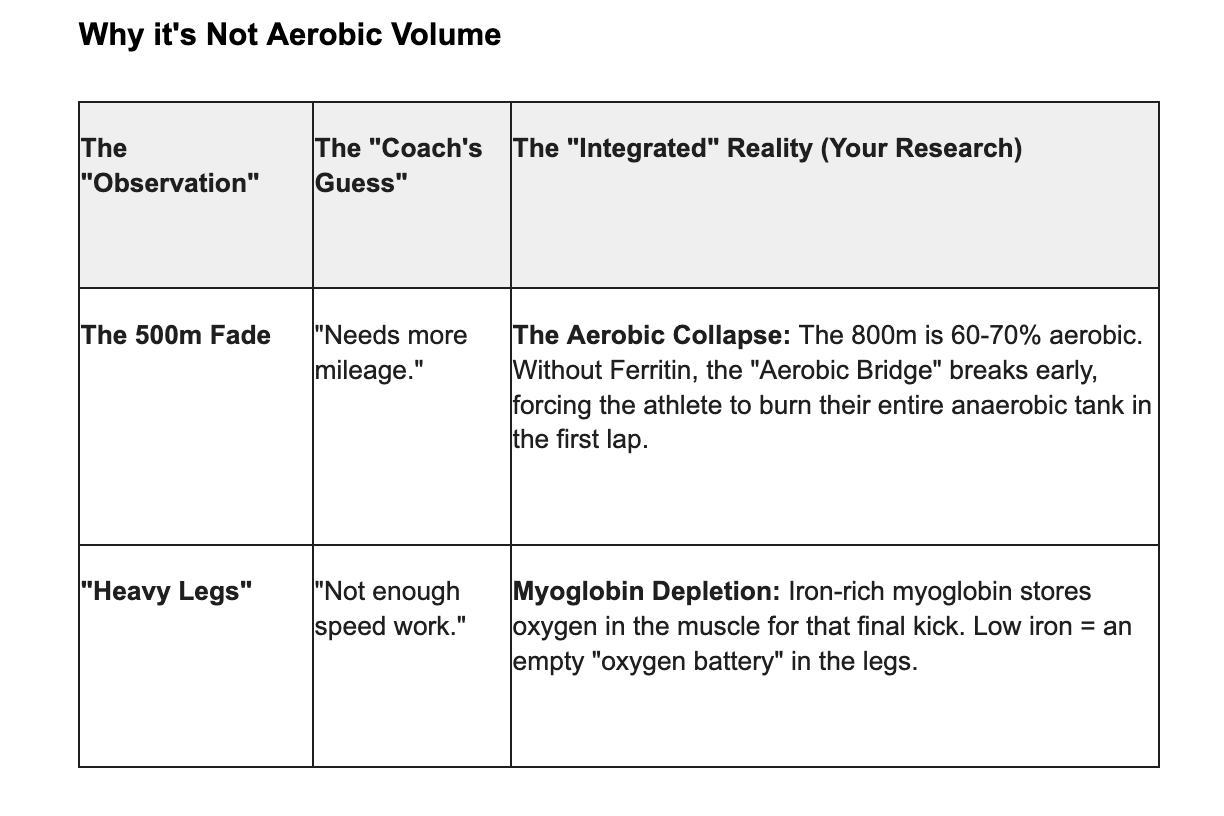
The 800m is roughly 60-70% aerobic (60% for males, 70% for females). Most people think sprints are pure power, but the 800m is the ultimate "Logistics" test.
The Detail: If Ferritin is low, the aerobic contribution collapses early. This forces the body to "over-draw" from the anaerobic tank in the first 400m.
The Hook: "Why your 800m runner 'dies' at 500m: It’s not a lack of speed; it’s an aerobic deficit caused by an empty iron tank."
2. Myoglobin: The "Oxygen Backup Battery"
While distance runners rely on hemoglobin for transport, 800m athletes rely heavily on Myoglobin—the iron-rich protein that stores oxygen directly in the muscle fibers for explosive use.
Localized Blackout: When Ferritin is low, Myoglobin is the first to suffer. The "bear on the back" in the final 100m is a localized Oxygen Blackout.
The Aerobic Bridge: Low iron forces the athlete to "over-draw" from their anaerobic tank in the first 400m, causing the Aerobic Bridge to collapse at the bell lap.
3. The "Lactate Myth" vs. Enzyme Logistics
One athlete I coached out of runner's anemia was told by the sprint coach that she needed a lactate test in a lab. That something was wrong with her to be producing so much lactate and unable to finish workouts or races. My research proves that Iron is a co-factor for oxidative enzymes (like cytochromes).
The Detail: Without enough iron, the enzymes that help "clear" or process lactate can't function. High lactate isn't the problem; it’s the symptom of an enzyme system that doesn't have the "iron tools" to keep up.
The Hook: "Stop testing the smoke (Lactate) and start fixing the fire (Iron-Dependent Enzymes).
4. The mTOR “Master Switch” & Ferritin
Most athletes view iron simply as an oxygen carrier, but at the cellular level, iron is a security deposit.
The Audit: The mTOR (mammalian target of rapamycin) pathway constantly monitors nutrient availability.
The Lock: If Ferritin (iron storage) is low, mTOR detects a "Supply Chain Crisis." To protect the heart and brain, it revokes Biochemical Permission to power the muscles.
The Result: The 500m "Wall" is actually the Software (mTOR) cutting power to the Hardware (Legs) because the iron warehouse is empty.
5. The Neural "Firing" Delay (Tyrosine Hydroxylase)
Iron is a mandatory co-factor for Tyrosine Hydroxylase, the engine for Dopamine and Serotonin.
The Slow Signal: Low iron slows the "Signal Logistics" from the brain to the legs.
The "Heavy" Feel: The athlete feels "slow-twitch" because the neural signal is physically delayed. This is a Neural Log-Jam, not a lack of speed work.
Whether you’re the parent watching your kid or the athlete experiencing the "run backwards" in the final 300m of an 800m it is heartbreaking and confusing—especially when the coach's answer is usually "more miles" or "more grit."
Example: She went from running consistently in the 2:20’s to 2:30’s and not knowing why.
The good news is that you should be able to reverse this pretty quickly, you’ll notice within a couple of weeks an improvement in how you feel. For me it took 3 years to get to optimal but I did feel better at every level of improvement. And with other athletes I’ve advised on this, they were able to correct it enough by the end of the season.
From my research, I have the "Hard Evidence" to show you it isn't a lack of training; it’s a Logistics Failure at the cellular level.
The "Neural Log-Jam": The Missing Link
The neural component—Iron is a mandatory co-factor for the enzymes that produce Dopamine and Serotonin—the "Signal Logistics" of the brain.
The "Slow Signal": When Ferritin is low, the brain's ability to send high-speed explosive signals to the legs is literally slowed down.
The "Safety Brake": The brain senses the oxygen deficit (low myoglobin) and the skyrocketing acidity (lactate) and pulls the "Emergency Brake." The athlete isn't "quitting"; their nervous system is physically slowing them down to prevent cellular damage.
You aren’t running out of grit; you are running out of Logistics. Why 50 more miles won't fix a 500m fade. Get your numbers checked and go for optimal not normal. I’ve posted what to look for on my blog post ATHLETES AND NUTRITION.
It is important to remember:
The "Cytochrome" Factor: It’s not just about oxygen; iron is a co-factor for the enzymes that clear lactate. When an athlete "dies" at 500m, they are literally drowning in metabolic waste because their "Iron Tools" are missing.
The Neural "Firing" Delay: Iron is required for Tyrosine Hydroxylase, the engine for Dopamine. If that engine stalls, the signal from the brain to the legs slows down. This is the "heavy legs" feeling—it’s a Neural Log-Jam.
The "Safety Brake": The brain senses the oxygen deficit and pulls the plug to protect the heart. The athlete isn't "quitting"; their Central Governor is forcing a shutdown.
The Aerobic-Anaerobic Bridge (60%-70%)
The Logistics: The 800m is up to 70% aerobic for female athletes. If Ferritin is low, the "Aerobic Bridge" collapses at the bell lap.
The Result: The athlete "over-draws" from their anaerobic tank too early, leading to a localized Oxygen Blackout in the muscle fibers.
The Data: I saw this first hand when my 800 dipped to 2:38.91. It mirrored the exact moment your "Aerobic Bridge" vanished due to nutrient insolvency.
The "Normal vs. Optimal" Conclusion
Clinical "Normal" (Ferritin 20–30) is a state of Active Anemia for the 800m runner. To maintain a 2:15 pace or faster, the athlete requires Optimal Logistics: a Ferritin threshold near 100-150 ng/mL to ensure the "Neural Signal" remains fast and the "Aerobic Bridge" remains intact.
The Reality:
Her mTOR pathway (the cellular Energy Auditor) has detected a lack of iron and oxygen.
To protect her heart and brain, the system revokes permission to power the legs.
She isn't "weak"; she is Insolvent. Telling her to "be tougher" is like telling a car to "be faster" when the fuel line is severed. It’s not a character flaw; it’s Metabolic Gaslighting.
When we blame a young girl's "mental game" for a performance drop caused by low Ferritin (22 ng/mL), we are teaching her to distrust her own body's signals.
Most of those sport psychology authors are writing from a position of Biological Solvency. They have the luxury of "Grit" because their "Warehouse" is full.
I’ve explained how the mTOR switch works, giving you the "Evidence" you need to tell your coaches: "I don't need a sports psychologist; I need a Hematologist and a different training/recovery load.
The 800m race is not a test of "Grit," but as a test of Biochemical Permission.
Sonja and Jennifer are sharing their personal experiences. This is being provided for informational purposes only. We are not giving medical advice and you should always consult your own doctor for advice related to your own health.
Bibliography
Peeling et al. (2014): The definitive work on Hepcidin and how training stress locks the "Iron Gates."
Medbø and Tabata (1989): Proving the 800m is up to 70% aerobic, making iron non-negotiable.
Beard et al. (NIH): Establishing iron’s role in Dopamine synthesis and neural signal speed.
Abstract & Citation Note
This synthesis identifies the Bio-Chemical Explosion required for the 800m and the specific nutrient insolvencies that cause systemic collapse. By analyzing three decades of performance data—including a 15-second reclamation jump (2:38 to 2:23)—this protocol establishes that the "final lap fade" is a Logistics Failure, not a lack of "grit" or aerobic volume.